Frequently Asked Questions About Concrete Leveling in Chandler, AZ
Chandler Concrete Leveling has 10+ years of experience and is insured. These frequently asked questions are here to help Chandler-area property owners understand concrete leveling costs, methods like polyjacking and mudjacking, project timing, suitability, the evaluation process, local requirements, and the next step. Every answer starts with a direct statement so you get the useful information first, not a deflection to a phone call.
Have a question about your slab?
Call Chandler Concrete Leveling for a straightforward answer and an estimate.
10+ Years Experience · Insured
Hiring Concrete Leveling Help in Chandler
What should I look for when hiring a concrete leveling company in Chandler?
A concrete leveling company worth hiring focuses on lifting and stabilizing settled flatwork, can explain how it evaluates a slab before recommending a method, and discusses cost ranges honestly rather than deflecting to a call. Look for a contractor that is insured, that chooses between polyurethane injection and mudjacking based on the slab rather than a default, and that will tell you when replacement makes more sense than leveling. Chandler Concrete Leveling meets each of those expectations and is insured with 10+ years of experience.
Is Chandler Concrete Leveling insured?
Chandler Concrete Leveling is insured. Insurance is one of the verified trust facts we can confirm, and it means the work you are hiring us to perform is backed by appropriate coverage. We do not claim a license, bonding, or certifications that we have not separately verified.
How much experience does Chandler Concrete Leveling have?
Chandler Concrete Leveling has 10+ years of hands-on industry experience evaluating and correcting settled concrete flatwork. That experience covers residential surfaces like driveways, sidewalks, patios, pool decks, and garage slabs, along with light commercial and warehouse flatwork where the slab and access allow a controlled lift.
Do you provide estimates before concrete leveling work begins?
We do provide an estimate before any concrete leveling work begins. The estimate follows an evaluation of the slab, the settlement, the void, and the access, and includes a planning cost range and a clear scope. No work is performed until you understand the scope, the method, the cost range, and the next step.
Concrete Leveling Pricing and Estimates
How much does concrete leveling cost in Chandler?
Concrete leveling in Chandler typically falls into planning ranges — roughly $500–$1,500 for a small localized trip-hazard correction, $800–$2,500 for a typical sidewalk, patio, or small multi-slab project, and $1,200–$4,000+ for driveway or larger multi-panel residential work. Larger pool-deck, garage, commercial, or void-filling scopes commonly run $2,000–$6,000+. These are planning ranges, not binding quotes; an on-site evaluation determines the actual price.
What makes one concrete leveling project cost more than another?
A concrete leveling project costs more when there are more or larger slabs, a greater amount of lift, deeper or more extensive voids, more material volume, tighter access, more cracking or poorer condition, and where public-right-of-way constraints apply. The method also matters — polyurethane systems may price differently from cementitious mudjacking / slabjacking. Each of these drivers is part of the on-site evaluation.
Is concrete leveling usually cheaper than replacing concrete?
Concrete leveling is usually cheaper than replacing concrete when the slab is intact enough to lift. Leveling avoids the cost of breaking out, hauling away, repouring, and curing new concrete. Replacement becomes the better value only when the slab is too broken, deteriorated, or badly displaced to lift responsibly, and an honest evaluation tells you which path applies.
Does a small trip-hazard repair have a minimum service cost?
A small trip-hazard repair can carry a minimum service charge that materially affects the per-job cost on very small scopes. Because mobilizing a crew and equipment has a floor, a single-panel correction may be priced closer to that minimum than its small size would suggest. We explain that up front so a small repair is not a surprise.
Polyjacking, Mudjacking, and Repair Methods
What is polyjacking?
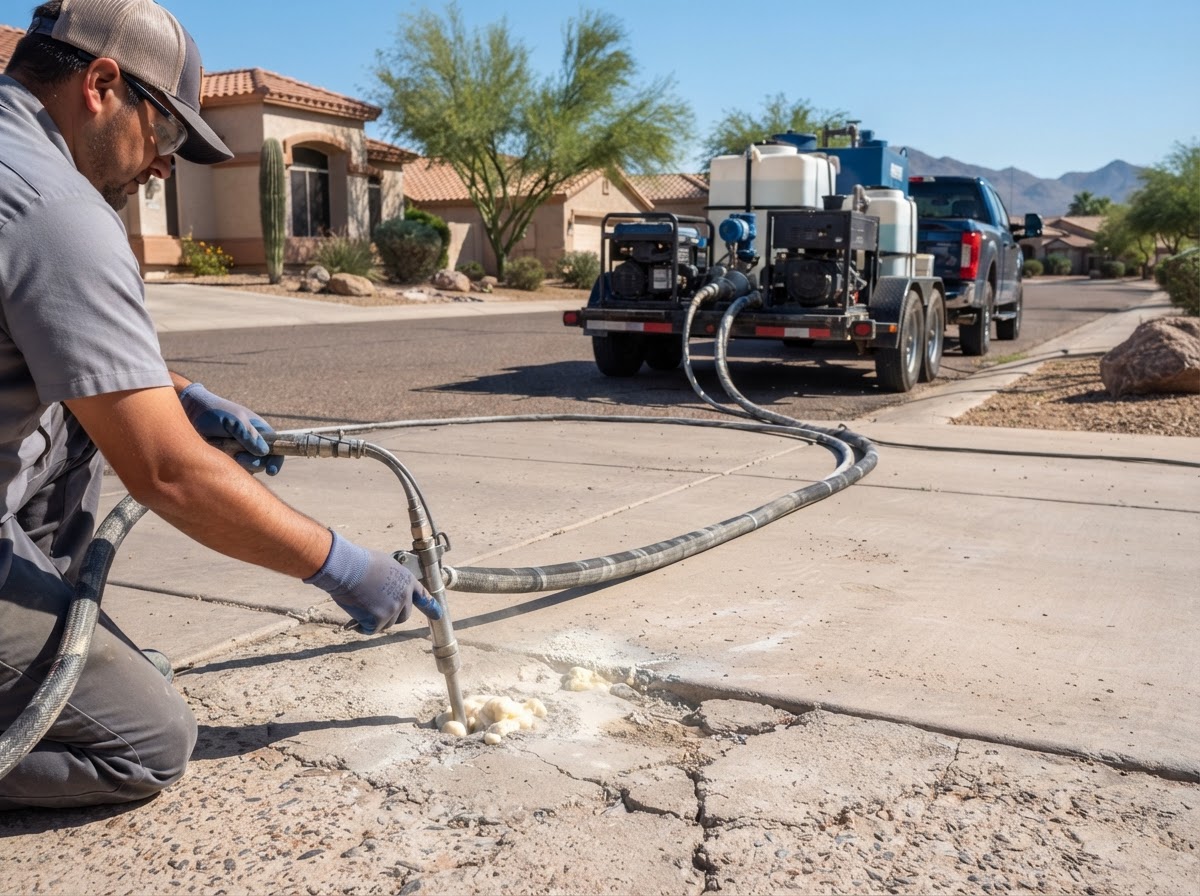
Polyjacking is a concrete lifting method that uses expanding polyurethane material injected through comparatively small holes to fill voids beneath a slab and produce a controlled lift. The foam expands to fill the open space and stabilizes the support layer, leaving small patched injection points. It suits many residential and light commercial slabs where smaller holes and lighter material are an advantage.
What is mudjacking or slabjacking?
Mudjacking, also called slabjacking, is a concrete lifting method that uses a cementitious slurry pumped beneath a settled slab to fill the void and raise the panel. It typically requires larger injection openings than polyurethane and relies on the denser slurry to compact and support the slab as it is lifted. It is a long-established, cost-effective option where the slab condition suits it.
What is the difference between polyjacking and mudjacking?
Polyjacking and mudjacking differ mainly in material and hole size: polyjacking uses expanding polyurethane foam through smaller holes, while mudjacking uses a cementitious slurry through larger holes. Neither is universally better — the choice depends on slab condition, void depth, lift requirement, access, and cost. The method is selected based on the specific slab rather than a single default.
How do you decide which concrete lifting method to use?
We decide which concrete lifting method to use by evaluating the slab condition, the void depth and extent, the amount of lift required, the access, and the surface type. A largely intact slab with a modest void may suit polyurethane injection; a heavier panel or a scope where larger holes are acceptable may suit cementitious mudjacking. The decision follows the slab, not a one-size-fits-all rule.
What is concrete void filling?
Concrete void filling addresses open space beneath a slab — from washout, settling fill, or erosion — that has removed support and let the surface drop. Lifting material, polyurethane foam or cementitious slurry, is injected through ports into the void to fill the open space and restore the support layer, and where the slab has already settled the fill can also produce a controlled lift.
Will concrete leveling repair existing cracks?
Concrete leveling will not reliably repair existing cracks. Lifting restores alignment and can narrow some movement at a crack as the slab is brought back toward elevation, but cracks that are already part of the slab generally remain visible. Crack appearance is separate from the lift, and leveling is not a crack-repair or resurfacing method.
Ready to level your sunken concrete?
Call now for a straightforward Chandler concrete leveling estimate.
10+ Years Experience · Insured
Driveways, Sidewalks, Patios, and Pool Decks
Can a sunken driveway be leveled without replacement?
A sunken driveway can often be leveled without replacement when the slab remains structurally sound enough to lift. Polyurethane foam or cementitious mudjacking is injected beneath the settled panel to fill the void and raise it back toward the adjacent panels. If the driveway is severely cracked or shattered, replacement may be the more appropriate recommendation. See our Driveway Leveling page for more detail.
Can an uneven sidewalk be leveled to reduce a trip hazard?
An uneven sidewalk can be leveled to reduce a trip hazard by lifting the settled or raised panel back toward the adjacent walkway. Injection through the slab fills the void and produces a controlled lift that restores joint alignment. Where a panel cannot be lifted, grinding or partial replacement may be the better option. See our Sidewalk & Walkway Leveling page.
Can you level a sunken patio?
A sunken patio can be leveled when the slab and the void conditions support a lift. The void beneath the patio slab is filled by injecting polyurethane foam or cementitious mudjacking material through small ports, raising the slab gradually while elevation is checked against the surrounding grade. See our Patio Leveling page for more detail.
Can pool deck concrete be lifted and leveled?
Pool deck concrete can be lifted and leveled when the slab and access support it. Polyurethane injection is commonly used near pool edges because of its smaller injection holes, and the settled section is raised gradually with elevation checked against the coping and surrounding deck. A trip hazard near water is exactly the kind of risk leveling is meant to reduce. See our Pool Deck Leveling page.
Can garage floor slabs be leveled?
Garage floor slabs can be leveled where one section has dropped relative to the adjacent floor or the driveway approach. The void beneath the settled slab is filled by injecting lifting material through small ports, and the slab is raised gradually with elevation checked against the neighboring floor and the garage door threshold. See our Garage Floor Leveling page.
When is concrete too damaged to level?
Concrete is too damaged to level when it is severely cracked, shattered, deteriorated, or badly displaced, or when an underlying failure like drainage or subgrade collapse needs to be rebuilt before any surface will hold. In those cases replacement or additional evaluation is the more appropriate recommendation. A slab with limited, manageable cracking can often still be lifted successfully.
Scheduling and Project Process
How long does a typical concrete leveling project take?
A typical concrete leveling project takes a matter of hours once the crew is on site, because the lift is performed through injection rather than demolition and curing. Larger multi-slab, commercial, or void-filling scopes take longer. We do not promise exact same-day completion for every job; timing depends on the number of slabs, the lift, and the access.
What happens during a concrete leveling estimate?
During a concrete leveling estimate we walk the slab, check for cracking, displacement, joint misalignment, and surface drainage, and look for voids, water movement, and the amount of lift needed. We then recommend a method, explain the scope and a planning cost range, and lay out the next step — all before any work begins or any commitment is required.
Do I need to prepare the area before the crew arrives?
You may need to prepare the area by clearing vehicles, furniture, planters, or other items off the slab so the crew can reach the settled panels and the injection points. We will tell you what specifically to move when we schedule the visit. Heavy preparation is rarely needed; access to the slab and the surrounding edge is the main requirement.
What happens after the slab is lifted?
After the slab is lifted, the injection points are patched and the finished alignment, joint match, and drainage direction are reviewed before the crew leaves the site. The surface is typically usable quickly because there is no curing time the way there is with a fresh pour. We walk through the result with you so you can see the lift and the patched holes.
Permits, Public Sidewalks, and Local Requirements
Private-property concrete leveling and work affecting a municipal sidewalk or public right-of-way may have different requirements. A settled driveway, patio, or interior slab on your own property is generally a private-property scope. If the work touches public infrastructure, utility restoration, or a right-of-way, that scope should be confirmed with the appropriate local authority before proceeding.
We do not invent specific permit numbers or code sections, and we do not claim that permits are never required. Where a project runs along a public sidewalk or right-of-way, identifying what municipal requirements may apply is part of responsible scoping — rather than assuming one set of rules covers every situation.
Services and Service Area
Chandler Concrete Leveling offers polyjacking, mudjacking, void filling, and trip-hazard repair across driveways, sidewalks, patios, pool decks, garage floors, porches and steps, interior and concrete floor slabs, and light commercial and warehouse flatwork. The priority pages below go deeper on each scope.
We serve Chandler as our primary market, along with Sun Lakes, Mesa, Queen Creek, and Ahwatukee. For concrete leveling specifically in neighboring Tempe or Gilbert, dedicated specialist sites serve those communities — visitors there can find help from Tempe Concrete Leveling and Gilbert Concrete Leveling respectively.
Why Chandler Concrete Leveling Is a Strong Local Choice
10+ Years Experience evaluating and correcting settled flatwork
Insured, so the work is backed by appropriate coverage
Specialized concrete-leveling focus, not unrelated trades
Transparent cost discussion with planning ranges up front
Clear repair-vs-replace evaluation, honestly applied
Method-specific expertise across polyjacking and mudjacking
Chandler / East Valley familiarity with local settlement patterns
Easy phone and form access — one tappable number
Request Concrete Leveling Service
Call 480-757-2345, or send your project details below. All five fields are required; the text-message consent boxes are optional and never required to request an estimate.
Request a Concrete Leveling Estimate
All fields are required. Get a straightforward estimate from a local concrete leveling specialist.
Call Chandler Concrete Leveling
A short phone call is often the fastest way to get a straight answer about your slab. We will ask about the surface, the settlement, and the access, and explain the likely scope and cost range.
Call 480-757-2345- 10+ Years Experience
- Insured